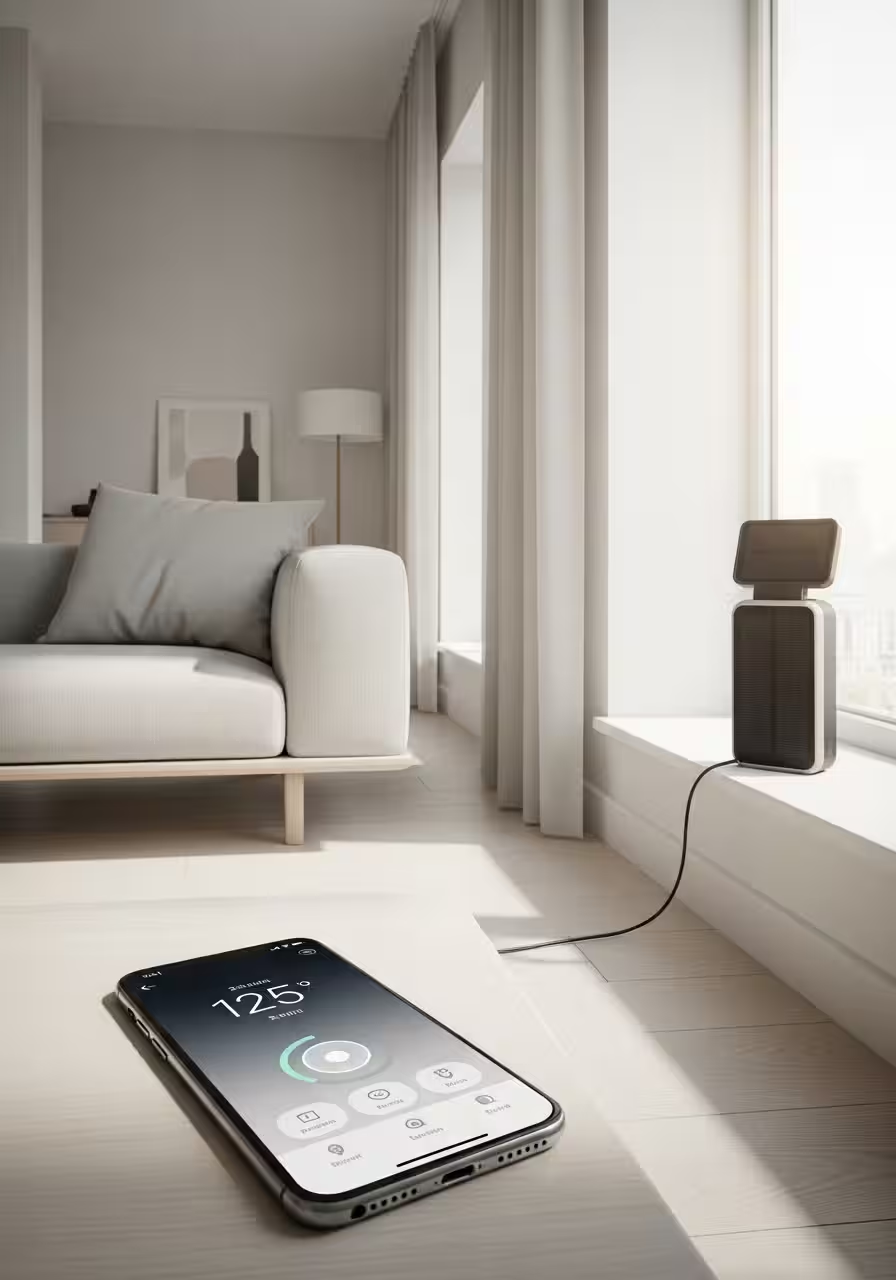
Outsmarting rising utility costs while upgrading your home’s IQ
Your electricity bill arrived this month, and once again, the number made you wince. Meanwhile, your thermostat is cooling an empty house, your water heater is working overtime, and you’re essentially hemorrhaging money to keep the lights on. Sound familiar?
Here’s the truth that utility companies don’t advertise: the smartest way to save money isn’t by suffering through sweltering summers or shivering winters. It’s by making your home intelligent enough to stop wasting energy in the first place.
Welcome to the era of energy independence, where technology doesn’t just add convenience—it actually pays you back.
The New Math of Home Economics
Traditional advice about saving energy usually involves sacrifice: turn off lights, take shorter showers, wear a sweater indoors. But smart home technology flips this equation entirely. Instead of doing less with less, you’re doing more with dramatically less energy consumption.
The average American household spends roughly $2,000 annually on energy bills. Studies show that smart home devices can reduce energy consumption by 10-30%, translating to $200-$600 in annual savings. More importantly, these aren’t one-time savings—they compound year after year, while the initial investment remains fixed.
Think of it as installing a money-printing machine that happens to also make your life more comfortable.
Smart Thermostats: The Foundation of Energy Independence
If you’re going to make one upgrade to reduce your energy bills, start here. Smart thermostats like the Nest Learning Thermostat, Ecobee SmartThermostat, or Honeywell Home T9 are the heavyweight champions of energy savings.
How they pay for themselves:
Traditional programmable thermostats require you to set schedules manually—and let’s be honest, how many of us actually did that correctly? Smart thermostats learn your patterns automatically. They know when you leave for work, when you return, and when you’re sleeping. They adjust temperatures room by room based on occupancy sensors, and they can even respond to weather forecasts to pre-cool or pre-heat your home during off-peak hours when electricity is cheaper.
The Nest thermostat, for example, has been shown to save users an average of 10-12% on heating bills and 15% on cooling bills. For a household spending $150 monthly on heating and cooling, that’s roughly $270-$405 saved annually. With smart thermostats typically priced between $120-$250, you’re looking at payback in less than a year.
The intelligence factor:
Modern smart thermostats integrate with your entire smart home ecosystem. They can detect when you’ve left home via your smartphone’s location, turn off when you open windows (using door/window sensors), and even adjust based on humidity levels to maximize comfort while minimizing energy use. Some models like the Ecobee come with remote sensors that eliminate hot and cold spots by measuring temperature in multiple rooms.
Solar-Powered Gadgets: Free Energy, Literally
While solar panels for your entire home remain a significant investment, solar-powered gadgets offer an accessible entry point into energy independence. These devices harness free sunlight to power themselves, completely eliminating their draw from your electrical grid.
Smart solar outdoor lighting:
Solar pathway lights, security lights, and even solar-powered string lights have evolved far beyond the dim, unreliable versions from a decade ago. Modern options like Ring Solar Pathlight or Aootek Solar Motion Sensor Lights provide bright, reliable illumination without adding a cent to your electricity bill.
For outdoor security lighting alone, households can spend $50-$150 annually. Solar alternatives eliminate this cost entirely while providing the same (or better) functionality.
Solar-powered outdoor cameras and doorbells:
Security devices like the Ring Stick Up Cam Solar or Reolink Argus 3 Pro combine home security with energy independence. These cameras continuously recharge via solar panels, eliminating the need for battery changes or electrical wiring. Beyond the obvious energy savings, the installation flexibility means you can place cameras in optimal locations without worrying about power outlet proximity.
Solar attic fans and ventilation:
Solar attic fans reduce cooling costs by expelling hot air from your attic before it radiates into your living space. On sunny summer days—exactly when you need cooling most—these fans work hardest. They can reduce attic temperatures by 30-50°F, which translates directly into reduced air conditioning runtime and lower cooling bills.
Smart Power Strips: Eliminating Phantom Power Drain
Here’s an invisible enemy: phantom power drain. Even when turned “off,” many devices continue drawing power—televisions, gaming consoles, phone chargers, coffee makers. This standby power accounts for 5-10% of residential energy use, costing the average household roughly $100-$200 annually.
Smart power strips like the Kasa Smart Plug Power Strip or APC Smart Plug automatically cut power to devices when they’re not in use. You can set schedules (why should your TV draw power at 3 AM?) or control outlets remotely through smartphone apps.
The beauty of smart power strips is their simplicity. Plug them in, set your preferences once, and they silently save you money month after month. With prices starting around $25-$40 and potential annual savings of $100-$150, these are some of the fastest-ROI devices you can buy.
Smart Water Heaters and Leak Detectors: Stopping Energy (and Money) from Going Down the Drain
Water heating accounts for roughly 18% of your home’s energy consumption. Smart water heater controllers like the Aquanta or Rheem EcoNet allow you to optimize your water heater’s operation, heating water only when needed and at the most energy-efficient times.
But here’s where it gets interesting: smart leak detectors like Flo by Moen or Phyn Plus don’t just prevent catastrophic water damage—they identify inefficient water use patterns. That constantly running toilet? It could be costing you $200-$400 annually in wasted water. These systems alert you to leaks immediately and can automatically shut off your water supply to prevent damage.
The return on investment here goes beyond energy savings into damage prevention. A single water leak can cause thousands in damage, making the $400-$500 investment in a smart water management system look modest by comparison.
Smart Blinds and Window Treatments: The Forgotten Energy Savers
Windows are the weak point in your home’s thermal envelope. In summer, they let in heat; in winter, they let warmth escape. Smart blinds and shades like those from Lutron, IKEA’s FYRTUR, or MySmartBlinds address this by automatically adjusting throughout the day.
These systems can close blinds during peak heat hours in summer, open them to capture passive solar heating in winter, and adjust based on whether you’re home or away. The Department of Energy estimates that smart shading can reduce heat gain by up to 45% and heat loss by up to 25%.
While the upfront cost is higher than traditional window treatments—typically $200-$400 per window—the energy savings (estimated at 10-20% of heating and cooling costs) combined with the longevity and added home value make them a worthwhile investment for many homeowners.
Energy Monitoring Systems: Knowledge Is Power (Savings)
You can’t manage what you don’t measure. Energy monitoring systems like Sense Home Energy Monitor, Emporia Vue, or Neurio give you real-time visibility into exactly where your electricity is going.
These devices install in your electrical panel and break down your energy consumption by individual appliance and circuit. You’ll discover that your ancient refrigerator is costing you $150 annually in excess electricity, or that your gaming PC’s 24/7 operation is adding $200 to your yearly bills.
Armed with this information, you can make targeted upgrades and behavioral changes that generate the highest return. Many users report that simply having visibility into their energy consumption reduces usage by 5-15% through increased awareness alone.
The Compounding Effect: Building Your Energy Independence Stack
The real magic happens when these technologies work together. Your smart thermostat communicates with your smart blinds to optimize temperature control. Your energy monitor identifies vampire power drains that your smart plugs eliminate. Your solar-powered outdoor devices reduce grid dependency while your smart water heater shifts consumption to off-peak hours.
Each device individually pays for itself. Together, they create a synergistic system that transforms your home from an energy liability into an efficient, intelligent space that actively works to reduce costs.
The Investment Mindset: Calculating Your Payback Period
Let’s run some realistic numbers for a modest smart home energy upgrade:
- Smart thermostat: $200 (saves $300-$400/year)
- Smart power strips (3): $90 (saves $100-$150/year)
- Solar outdoor lighting: $200 (saves $75-$100/year)
- Energy monitor: $300 (enables 5-10% additional savings via awareness)
Total investment: $790 Conservative annual savings: $500-$700 Payback period: 13-19 months
After payback, these savings continue indefinitely while your initial investment remains fixed. Over a 10-year period, you’re looking at $5,000-$7,000 in cumulative savings for an initial $790 investment—that’s a 532-786% return.
Meanwhile, you’ve also increased your home’s resale value, improved comfort, gained convenience through automation, and reduced your environmental footprint. Not many investments offer that combination of financial return and lifestyle improvement.
Making the Transition: A Practical Roadmap
Start with the highest-impact, lowest-cost improvements and build from there:
Phase 1 (Months 1-2): Quick Wins Install smart power strips and begin monitoring their impact. These require no professional installation and start saving immediately.
Phase 2 (Months 3-4): The Core Investment Install a smart thermostat. This is your highest-ROI upgrade and sets the foundation for your smart home ecosystem. Many utility companies offer rebates that can reduce the cost by $50-$100.
Phase 3 (Months 5-6): Visibility and Optimization Add an energy monitoring system to identify specific consumption patterns and opportunities for additional savings.
Phase 4 (Ongoing): Incremental Additions Replace outdoor lighting with solar options as existing fixtures need replacement. Consider smart blinds when updating window treatments. Add smart water management when replacing or upgrading water heaters.
The Bottom Line: Your Home as a Financial Asset
Rising utility costs aren’t going away. If anything, energy prices are likely to increase as demand grows and infrastructure ages. But you don’t have to be a passive victim of these increases.
Smart home technology represents a fundamental shift in how we think about energy consumption. Instead of paying for waste, you’re investing in efficiency. Instead of sacrificing comfort for savings, you’re using intelligence to optimize both.
The question isn’t whether you can afford to make your home smarter—it’s whether you can afford not to. Every month you wait is another month of unnecessary energy bills, another $50-$100 that could have stayed in your pocket.
Your home is probably your largest financial investment. Isn’t it time it started working to make you money instead of costing you money?
The technology exists. The savings are proven. The payback is measurable. All that’s left is the decision to take control of your energy independence—and start slashing those bills.
Ready to start your journey toward energy independence? Begin by calculating your current energy costs and identifying which smart devices would generate the highest return for your specific situation. Your first step toward lower bills is just a smart decision away.
Leave a Reply